When I read John Green's Looking for Alaska as an undergrad at Rhode Island College, it was for an adolescent literature class. The class wasn't geared towards teaching students YA literature, but simply exposing us to what YA lit is and what students are interested in. In fact, I don't even remember getting the chance to discuss Green's novel in class. I recall spending more time on The Charlie Bone series and asking, "What is Twilight?!" (it was still new then) -- we weren't very productive, I must admit.
But now, reading Looking for Alaska with high school students and teaching in mind I see it in a very different way. I can't imagine any student that I know now picking up this book for class and rejecting it. There are innumerable connections that a young (or old!) reader can make to the text. Especially after reading some of what John Green has said about the novel -- it essentially exists for readers to ask questions and to wonder, not provide any answers or come to solid conclusions. This novel will show young readers that they needn't know exactly where there life is going, in fact, it supports not knowing at all, because that is the amazing part about life -- seeking a mysterious and uncertain "Great Perhaps."
This is a blog about books, reading, young adult literature, education, teaching, and learning to teach.
Showing posts with label novel. Show all posts
Monday, February 27, 2012
Sunday, February 19, 2012
During Reading Strategies
This week I've been working on a lesson plan focusing on one during reading strategy associated with a young adult novel. I chose The Book Thief to work with and the strategy of using post-its and logographic cues. Since my assignment was not only to teach a reading strategy, but to also focus on the text as a multicultural title, I have found it to be very challenging -- especially keeping it all within a single lesson.
As I read through Kylene Beers' chapter on during reading strategies, I immediately felt a connection with both the post-it strategy and the logographic cues. I feel that they are very compatible, so I decided to mesh them together into one strategy. This seemed especially logical since The Book Thief is rather a long text. Students will have a number of themes or topics to look for as they read and will use the post-its to take note of what they find. As I started to take notes on this strategy, I remembered that I am supposed to be thinking of the book in terms of multiculturalism. This revealed a challenge.
I found myself wondering how to tie these two ideas together -- especially in one, single lesson. As this strategy is used throughout the book and gets discussed over a number of classes, the multicultural aspects of the novel will organically reveal themselves. However, in teaching my students how to use this strategy as they read, I need to be sure that they are looking for the right things. Therefore, the logical tie-in would be to create a list of themes that they should be creating post-its for.
Since the novel is set in Nazi Germany I decided that two of my themes for students to look for would be "World War II" and "A Different Life:" students will be looking for details about the war (which, in the novel is generally presented from the Jewish point-of-view) and examples of how the lives of the characters differ from themselves. This should get them thinking of the novel as an example of how different life can be -- in a different country and at a different time.
Not only is meshing a during reading strategy with multicultural themes challenging, but being sure I do so all within one lesson. The time constraint of presenting all the right information seems unrealistic. I feel that were I to teach this lesson to a real class I would spend one, full class period focusing on the ins and outs of the strategy itself and another day on discussing the various themes they will be focusing on. However, for this particular assignment I will have to do both in one lesson. It can be done, but it is not the way that I would do it with a real class.
I feel that choosing a novel that depicts a different culture or lifestyle set in present time, rather than historical fiction, would have been easier for this assignment -- more obviously an example of multiculturalism. However, I love history and am particularly interested in World War II. I feel that The Book Thief is a fantastic way to show students what young people went through during the war in Germany -- it feels alive. I would love an opportunity to use this novel in my own classroom some day.
As I read through Kylene Beers' chapter on during reading strategies, I immediately felt a connection with both the post-it strategy and the logographic cues. I feel that they are very compatible, so I decided to mesh them together into one strategy. This seemed especially logical since The Book Thief is rather a long text. Students will have a number of themes or topics to look for as they read and will use the post-its to take note of what they find. As I started to take notes on this strategy, I remembered that I am supposed to be thinking of the book in terms of multiculturalism. This revealed a challenge.
I found myself wondering how to tie these two ideas together -- especially in one, single lesson. As this strategy is used throughout the book and gets discussed over a number of classes, the multicultural aspects of the novel will organically reveal themselves. However, in teaching my students how to use this strategy as they read, I need to be sure that they are looking for the right things. Therefore, the logical tie-in would be to create a list of themes that they should be creating post-its for.
Since the novel is set in Nazi Germany I decided that two of my themes for students to look for would be "World War II" and "A Different Life:" students will be looking for details about the war (which, in the novel is generally presented from the Jewish point-of-view) and examples of how the lives of the characters differ from themselves. This should get them thinking of the novel as an example of how different life can be -- in a different country and at a different time.
Not only is meshing a during reading strategy with multicultural themes challenging, but being sure I do so all within one lesson. The time constraint of presenting all the right information seems unrealistic. I feel that were I to teach this lesson to a real class I would spend one, full class period focusing on the ins and outs of the strategy itself and another day on discussing the various themes they will be focusing on. However, for this particular assignment I will have to do both in one lesson. It can be done, but it is not the way that I would do it with a real class.
I feel that choosing a novel that depicts a different culture or lifestyle set in present time, rather than historical fiction, would have been easier for this assignment -- more obviously an example of multiculturalism. However, I love history and am particularly interested in World War II. I feel that The Book Thief is a fantastic way to show students what young people went through during the war in Germany -- it feels alive. I would love an opportunity to use this novel in my own classroom some day.
Labels:
Beers,
classroom,
comprehension,
during reading,
novel,
reading,
students,
teachers,
teaching,
The Book Thief,
young adult literature
Location:
East Greenwich, RI
Friday, January 20, 2012
A Super Good Day
![]() |
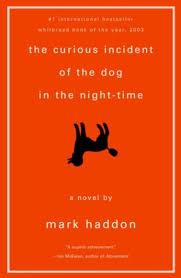
| (A good sign for Christopher, the narrator of The Curious Incident of the Dog in the Night-time) |
This rationale sounds exactly like something my nephew, Mikey, would say. Mikey is 7 years old, loves to make graphs on the calculator, his favorite sandwich is a cheese sandwich with shredded cheese (NOT a grilled cheese), is lovingly obsessed with the video game Portal, is a literal genius on the piano, and has Aspberger's Syndrome. He deals with anxiety, sensory overload, and some awkward social interactions. And he's amazing. Maybe I'm biased (I am his aunt and he is my only nephew, after all) but he's pretty much my favorite person. I'm always learning something new from him -- whether it's a fact about the element neon or intuitive insight to his world.
On Wednesday, I was sitting in a 12th grade English class and learned they were about to begin a new book. As I listened to Ms. Roman describe The Curious Incident of the Dog in the Night-time by Mark Haddon I decided that I would find the time to read it. She explained that the story is told from the point-of-view of a young boy dealing with Asperger's. She shared a list of common symptoms and characteristics that children on the Autistic spectrum deal with and specific Asperger's traits. I sat in the back of the room thinking of Mikey. I borrowed Ms. Roman's personal copy of the book and told her I might be able to finish it over the weekend, since I would be away in Vermont. I returned it to her on Thursday morning.
Throughout exams and study halls on Wednesday I devoured Haddon's novel -- by the time I got home I only had about 30 pages left and finished them quickly. Christopher, the main character, drew me into his world so fast and fully, I was surprised. The descriptions of his world gave me insight that made me really feel what he was going through. I felt that I understood his anxiety and his confusion as his story unfolded. Mark Haddon does an amazing job creating a bond between his readers and Christopher.
If you know anyone with Aspberger's, I recommend you read this book. If you don't know anyone with Aspberger's, I recommend this book even more. I am so glad Ms. Roman is using this novel in her class because it will share a new perspective of the world with students who are unfamiliar with the kinds of feelings and challenges kids like Christopher face.
A few selected quotes from the novel, to give you a taste of Haddon's style:
“On the fifth day, which was a Sunday, it rained very hard. I like it when it rains hard. It sounds like white noise everywhere, which is like silence but not empty.”
“A lie is when you say something happened which didn't happen. But there is only ever one thing which happened at a particular time and a particular place. And there are an infinite number of things which didn't happen at that time and that place. And if I think about something which didn't happen I start thinking about all the other things which didn't happen.
For example, this morning for breakfast I had Ready Brek and some hot raspberry milkshake. But if I say that I actually had Shreddies and a mug of tea I start thinking about Coco-Pops and lemonade and Porridge and Dr Pepper and how I wasn't eating my breakfast in Egypt and there wasn't a rhinoceros in the room and Father wasn't wearing a diving suit and so on and even writing this makes me feel shaky and scared, like I do when I'm standing on the top of a very tall building and there are thousands of houses and cars and people below me and my head is so full of all these things that I'm afraid that I'm going to forget to stand up straight and hang onto the rail and I'm going to fall over and be killed.
This is another reason why I don't like proper novels, because they are lies about things which didn't happen and they make me feel shaky and scared.
And this is why everything I have written here is true.”
Subscribe to:
Posts (Atom)